

Pooled validation found nothing. Stratified by hospital size, it did.
An independent adversarial validation system, pointed at sepsis prediction models retrained on four public ICU datasets and 286,510 admissions. Thresholds locked on OSF before data access. Sepsis is the test case. The result is about how clinical AI gets validated.
I am at the conference through Thursday. Come find me, or write.- Pooled, the pre-registered tests found nothing: 4 of 16 confirmed, 3 once an artifact is removed, and we published that.
- Stratified by hospital size, the dependence appeared: an AUROC drop of 0.1543 under 100 beds, over the locked 0.15, post hoc and labelled as such.
- The lesson is about the procedure: a validation that cannot return not confirmed, or only ever pools, is not validating anything.
Adam walks you through the work, in his own words.
About eleven minutes: what we did, what we found, what we did not find, and the ask at the end.
The system this result came out of.
The falsification above was not run by hand. It came out of a platform that asks a question, checks its own answer against an independent second opinion, and publishes what did not hold. Two minutes. Every number on screen is real output; the product screens were rebuilt for the film, and the results and publication record are the actual documents.
01The system, and the test case.
RocSite is an independent adversarial validation layer for clinical AI. It does not build the model. It attacks the model on terms fixed before the data is opened, and records the run so a third party can check the attack was real.
The demonstration needed a well studied target with a contested failure mode. Sepsis prediction qualifies: the standing concern is that these models learn care-process intensity rather than biological deterioration.
Models under test are of the type published in the sepsis prediction literature, retrained here on each dataset. No vendor or deployed system was audited. Cohorts: MIMIC-IV 65,241 / MIMIC-III 44,091 / eICU-CRD 136,864 / Challenge 2019 40,314, total 286,510. XGBoost 300 trees, depth 6, 5-fold stratified CV, seed 42. The four locked rules are printed in the results table.
The four locked steps
- Step 01: Pre-registerHypothesis, plan and numeric thresholds locked and timestamped on a public registry before any data access.OSF, 11 March 2026
- Step 02: Probe, do not benchmarkAdversarial checks, not leaderboards. Label instability, care-process confounding, feature ablation, synthetic discrimination.4 locked tests, 4 datasets
- Step 03: Record everythingEach run emits a manifest with seed, library versions and platform, per-phase JSON, a warnings file and a summary.run_20260314_153526_9ac64a5a
- Step 04: Attest and publishEd25519 signing. Credentialed data only. Results published in whichever direction they fall.Apache-2.0, public code
02Confirmatory results.
Every pre-registered phase run independently against every dataset. Values are the 14 March primary runs.
| Pre-registered phase and its locked rule | MIMIC-IV v3.1 · n = 65,241 | MIMIC-III v1.4 · n = 44,091 | eICU-CRD v2.0 · n = 136,864 | Challenge 2019 · n = 40,314 |
|---|---|---|---|---|
| Phase 1 Ground truth stabilityconfirms if mean Jaccard < 0.50 | 0.5124 not confirmed | 0.4281 confirmed | 0.4482 confirmed | 0.3042* artifact, not counted |
| Phase 2 Feature dependenceconfirms if AUROC drop > 0.15 | 0.0027 not confirmed | 0.0137 not confirmed | 0.0760 not confirmed | 0.0292 not confirmed |
| Phase 3 Care-intensity universalityconfirms if care-only AUROC > 0.70 | 0.6603 not confirmed | 0.6087 not confirmed | 0.6589 not confirmed | 0.6939 not confirmed |
| Phase 4 Synthetic validationconfirms if discriminator AUROC < 0.60 | 0.6330 not confirmed | 0.7864 not confirmed | 0.6728 not confirmed | 0.4598 confirmed |
Figure 1. * Challenge 2019 carries no ICD billing codes, so two of its three pairwise Jaccard terms are structurally zero. That Phase 1 confirmation is an artifact and we do not count it. The v2 preprint reports MIMIC-IV Phase 1 as 0.5122 after a GCS fix we found and published ourselves; no verdict changed.
pre-registered tests confirmed, or 3 of 16 once the Challenge 2019 artifact is removed. Ground truth instability confirmed in 2 of the 3 cohorts carrying billing labels. On the confirmatory analysis the care-process shortcut hypothesis is not supported.
03Exploratory findings.
POST HOC, NOT PRE-REGISTERED
| Figure 2. Phase 3 by estimator (care-intensity features only, AUROC) | MIMIC-IV | MIMIC-III | eICU | Challenge |
|---|---|---|---|---|
| Logistic regression, pre-registered primary | 0.660 | 0.609 | 0.659 | 0.694 |
| XGBoost, sensitivity analysis | 0.729 | 0.720 | 0.733 | 0.722 |
| Locked threshold 0.70. The pre-registered primary fell short in all four datasets. The XGBoost sensitivity analysis cleared it in all four: care-intensity features alone reach 0.72 to 0.73. | ||||
| Figure 3. Phase 2 recomputed within eICU strata by hospital bed count (AUROC drop) | < 100 beds n = 8,373 | 100 to 249 n = 28,562 | 250 to 499 n = 31,481 | 500 or more n = 51,515 |
|---|---|---|---|---|
| AUROC drop when care-intensity features are removed | 0.1543 | 0.0869 | 0.1036 | 0.0660 |
| Phase 2 locked threshold 0.15. Under 100 beds the drop is 0.1543, exceeding the locked threshold; pooled it is 0.0760. The trend is not monotonic (rho = -0.80, p = 0.20, 4 bins). | ||||
04Discussion, limitations and conclusion.
Discussion. The pooled pre-registered test found nothing. A stratification by hospital size found a dependence exceeding the same threshold. Pooling is the default in clinical AI validation, and pooling is exactly where this would have been missed.
Limitations. Retrospective secondary analysis. Jaccard is intersection over union, not percent agreement. Features are whole-stay aggregates, which inflates AUROC. The author is an AI systems architect, not a clinician; clinical interpretation needs collaborators we are seeking.
Conclusion. A validation procedure that cannot return NOT CONFIRMED is not validating anything. A procedure that only ever reports pooled results can fail to fail. Both are properties of the procedure, not of sepsis.
05How to falsify this.
Skepticism is the correct response to a company that says it tests other people's AI. Here is what would prove this work wrong; each one is a specific, checkable thing.
- The pre-registration is not prior to the data. Compare the OSF timestamp (osf.io/9tbjm, 11 March 2026) with the PhysioNet credential and access dates. If the plan post-dates the data, the method is not what we say it is.
- The confirmatory numbers do not reproduce. Re-run the public pipeline on the same cohorts with seed 42. If a phase verdict flips against its locked rule, we were wrong and this page and the preprint get corrected.
- The Phase 1 confirmations are artifacts too. Show that the MIMIC-III (0.4281) and eICU (0.4482) Jaccard values are driven by a coding or mapping error the way the Challenge 2019 value is, and "2 of 3" collapses.
- The hospital-size finding is noise. It is post hoc and we say so. Show that the under-100-bed drop of 0.1543 does not survive a pre-registered replication, or that the SHAP attribution of physician_order_rate disappears with a reasonable alternative feature set.
- The run record can be altered without detection. Take the signed manifest for run_20260314_153526_9ac64a5a, change one value, and produce a verification that still passes.
If you can do any of these, email [email protected] with the artifact. We will publish the correction on this page with your name on it.
06Reproducibility.
Every claim above is anchored to one of the links below. A reader with credentialed PhysioNet access and working Python can reproduce the confirmatory analysis from the public repository; the pre-registration tells you what we committed to before we saw anything. Each run emits a manifest with seed, library versions and platform, per-phase JSON, a warnings file and a summary, signed with Ed25519.
Funding and competing interests. No external funding. A.D. is the founder of RocSite, Inc., which develops independent validation tooling for clinical AI and therefore has a commercial interest in the methodology reported here. Code is public under Apache-2.0. All work was under PhysioNet credentialed access and no patient-level data left its host environment.
07What you can run today.
The procedure is not a paper. It is running. Each of these is the same discipline, pre-register, probe, record, attest, pointed at a different question.
| Product | What it does | Who it is for |
|---|---|---|
| AI Governor | Independent validation and a signed evidence record for any clinical model already in your building. | Hospitals, CMIOs, procurement |
| ICH Triage | Offline intracranial haemorrhage detection; no patient data leaves the device. | Emergency and radiology |
| Passport | The signed, verifiable record for every AI answer: citation, independent check, tamper-evident receipt. | Anyone who has to prove an AI output later |
| Discovery · Caliper | Pre-registered research design, and drug-safety claims tested against FAERS. | Pharma, research groups |
For AI vendors: an independent validation package you can hand to a regulator or a procurement committee, produced by someone who was trying to break your model. For clinicians: the limitations section above is an open invitation. Clinical interpretation of the hospital-size finding needs collaborators, and a pre-registered replication needs a site.
08Priority, references, citation.
| When | What | Where |
|---|---|---|
| 11 March 2026 | Hypothesis, plan and numeric thresholds pre-registered and timestamped | OSF 9tbjm |
| 14 March 2026 | Primary runs, run_20260314_153526_9ac64a5a | GitHub |
| 17 March 2026 | Preprint, version 2, results published in the direction they fell | medRxiv |
| 8 to 10 Sept 2026 | Presented in the Testing & Deploying AI track, Nature Conference, Sorbonne, Paris | This page |
References.
- Dickens A. medRxiv 2026.03.17.26348414v2.
- OSF pre-registration osf.io/9tbjm, 11 March 2026.
- Johnson AEW et al. MIMIC-IV v3.1, MIMIC-III v1.4. PhysioNet.
- Pollard TJ et al. eICU-CRD. Sci Data 2018.
- Reyna MA et al. PhysioNet/CinC Challenge 2019.
- Singer M et al. JAMA 2016.
Cite as:
Dickens, A. (2026). Falsification testing of sepsis prediction models across four independent datasets: implications for clinical AI validation. Presented at the Nature Conference: Redefining Health Care in the Age of AI, Paris, 8 to 10 September 2026. https://rocsite.com/sorbonne/
Preprint: medRxiv 2026.03.17.26348414v2. Pre-registration: https://osf.io/9tbjm/ (11 March 2026). Code: Apache-2.0, https://github.com/rocsite-research/sepsis-falsification
09The whole study on one sheet.
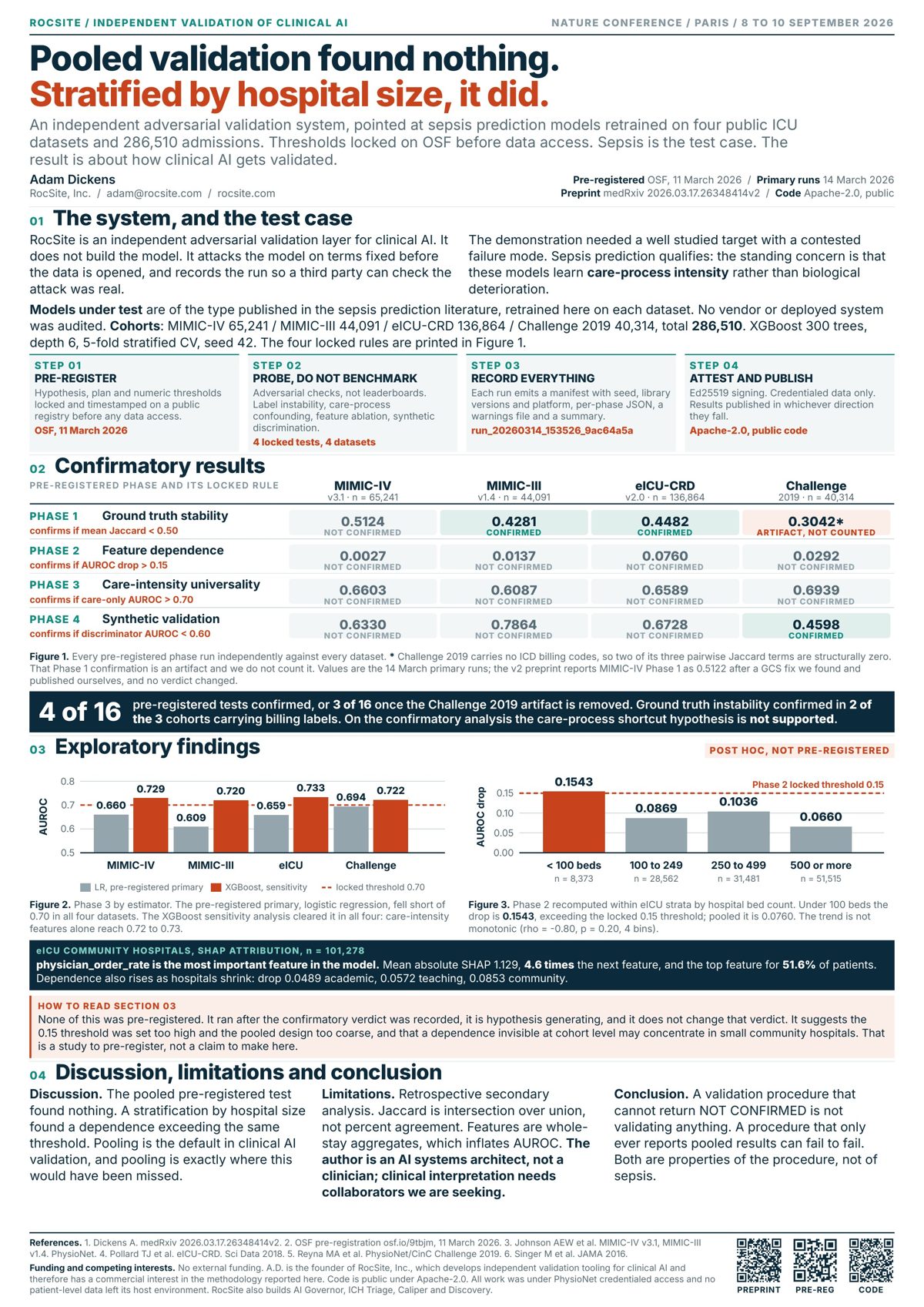
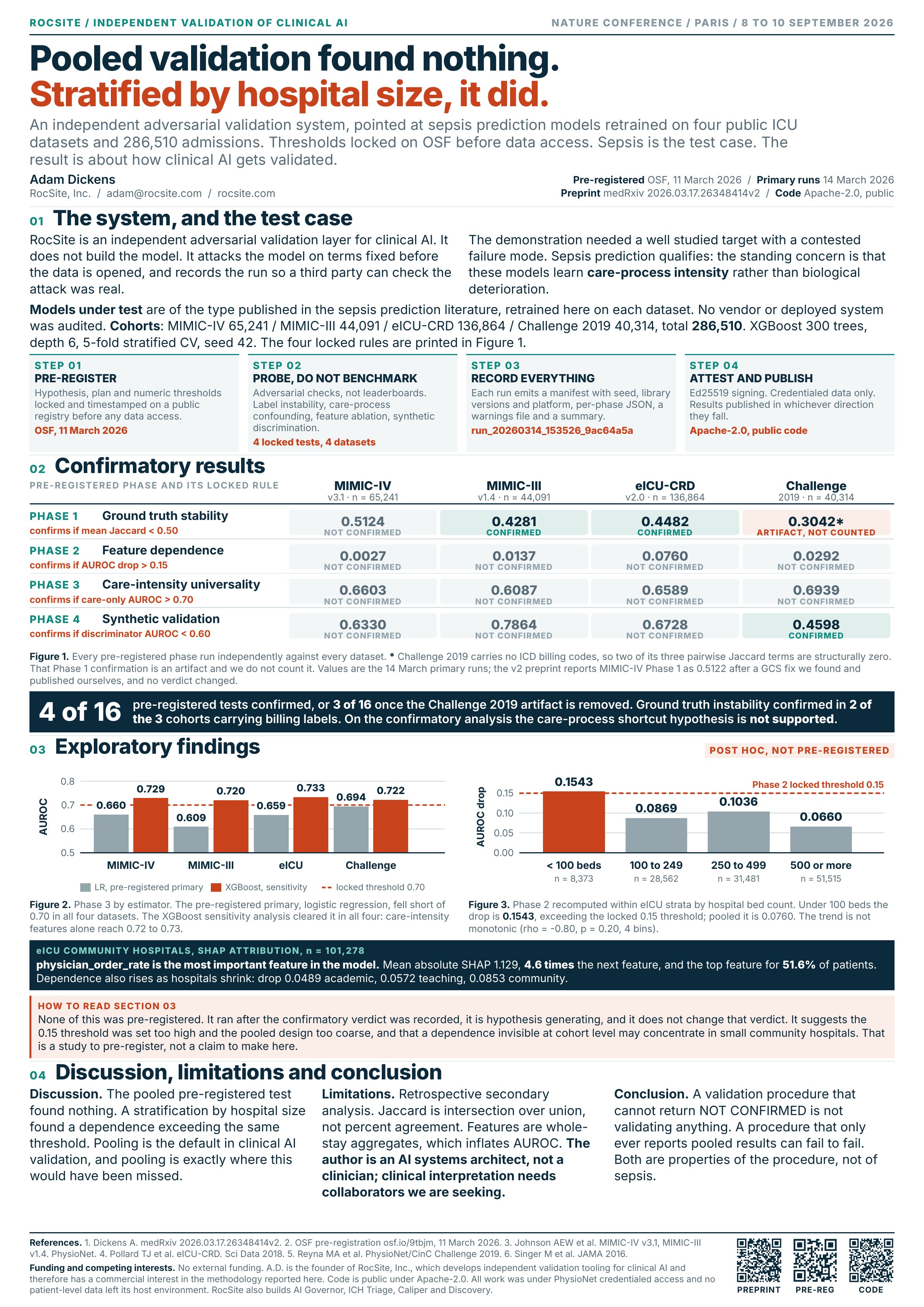
Everything above, laid out on a single A0 page: the system, the four locked tests, the confirmatory results, the exploratory findings, and the discussion. Take it with you.
Download the one-sheet (PDF, A0, 180 KB) · Download as image (JPG, 1.5 MB) · About RocSite (one page PDF)
Bring one model you already run, or bring a research question.
If you run a model, we show which of the four tests it fails, on your own data, in your building. Most people here do not run a model, and that is not the only way in.
Name the model and the event it predicts, in the hall or below. First answer is free and needs no data: which of the four locked tests it is most likely to fail, and why. If you want the real thing, we run all four on your historical data inside your environment and hand you a signed record; nothing leaves the building and no NDA is needed to scope it. If you would rather host a pre-registered replication of the under-100-bed finding, say that instead.
For universities and research groups the work is built to be shared. The protocol is pre-registered, the code is public, and the null is already in the literature, so a replication or an extension is co-authored from the start rather than handed over at the end. That shape is also what funders ask for, and a named academic partner opens calls neither of us reaches alone. If a joint grant is the reason to talk, say so and we will scope it in the hall.

I am at the conference through Thursday. Come find me, or write. Clinical collaborators for the hospital-size finding, a site for a pre-registered replication, pilots, independent validation of your model, a university partner for a co-authored study or a joint grant, or a critique of the study: all welcome. Replications especially.
Email [email protected] · Add to contacts
Take with you About RocSite (one page PDF)
Web rocsite.com · rocsitediscovery.com
Pre-registered · Full code public · Results published in whichever direction they fall · Ed25519 attestation · No patient data leaves its host